Showing posts with label monsters. Show all posts

Sunday, February 2, 2014

Stationery Vermin

There are lots of monsters said to be the result of magical experiments, and so are the creatures known as stationery vermin. It seems plausible indeed that these pests were an invention of an office working mage, cleric, or clerk who was tired of misplacing his scissors or pencils. Whatever the truth, now stationery vermin are breeding, and have become a nuisance in any office environment.

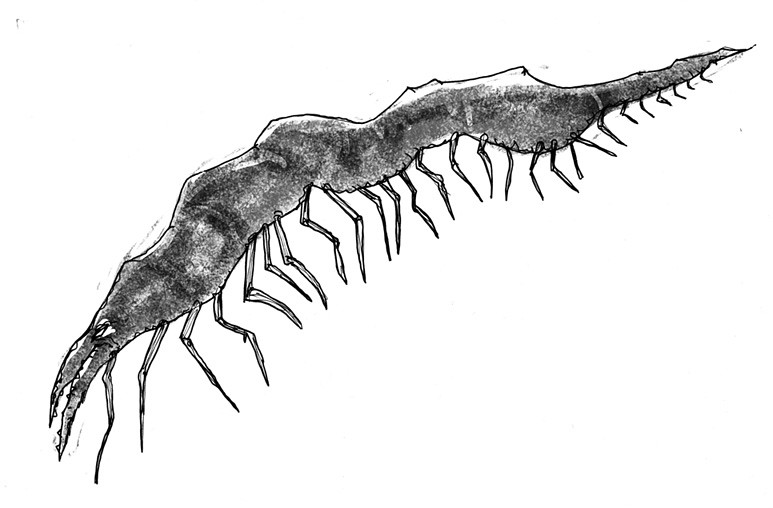
Stationery vermin are small creatures, about the size of rats. Each has a piece of office supplies for a head: scissors, a stapler, a pencil, etc. They can be either bipedal and quadrupedal, and there are species that are bird-like and can fly. Apparently, these shapes are independent of the type of stationery – there are both running and flying scissorheads, for example.

Stationery vermin can be trained to follow orders.

Stationary Vermin (2d12): AL N; MV 150’ (50’), (birdlike vermin have 180’ (60’) flying); AC 7; HD 1-2 hp; #AT 1 (bite); Dmg 1; Save Human0; M 5; XP 6. In addition, every type of stationery has a special attack or ability, as given below.

Eraserhead. Erase: At will, the eraserhead can erase magical writing as the 1st-level magic-user spell.

Glue-Tubehead. Glue: The glue-tubehead can cover any surface with a sticky substance. Creatures touching the glue cannot mow, unless a Str-check is made. If the check is unsuccessful other actions to free oneself can be taken (for example, taking of ones boots or gloves).

Pencilhead: Illusory script: Once per day, the pencilhead can disguise it’s writing as per the 3rd-level illusionist spell illusory script.

Scissorhead: Cut: The attacks of the scissorhead do 1d6 damage.

Staplerhead: Staples: The attacks of a staplerhead do 1d4 damage.

Tape-Dispenserhead. Constriction: if the tape-dispenserhead’s attack hits, its target’s legs are constricted, making it impossible to walk without falling (1d4 dmg).

Wednesday, October 16, 2013

Orc Babies

I’ve seen a lot of discussion about Mearls’ 5E articles and the rules-side of the game, but there’s been hardly any conversation about James Wyatt’s “Wandering Monsters” column. There should be, because it’s terrible. In the column, Wyatt discusses monsters, and their role in the D&D game and world. The results are often uninspired, or they come completely out of the blue.

Apparently, the goal is to create monster concepts that can include both the AD&D/3E version of a monster, and the 4E version. Sounds good, but the result is often a wishy-washy, watered down monster. I’m no fan of the changes 4E made to some of the monsters, but at least there were concepts behind them (even if they were weak concepts).  For example, the much-lamented Devil Succubus was a dumb idea, but at least it was a Devil. In 5E, the Succubus will be nothing. They’re watering down the concept even more. Furthermore, Wyatt’s articles make for dry reading, and that doesn’t bode well for the 5E Monster Manual.

Last week’s article, “You Got Science In My Fantasy” touches upon a topic I’ve been meaning to write about:

Orc Babies
Let’s get one thing straight: no orc is a “non-combatant”. The idea that encountering orc babies is an interesting “moral dilemma” or “philosophical discussion” is an often repeated adventurer legend that’s not true. It's up there with "Bree-yark means I surrender" and "Succubi are great kissers".
Orc babies are vicious, nasty little critters: balls of fur with razor-sharp teeth, an unrelenting hunger for fresh meat, and the ability to jump from the floor straight on a man’s face.

Orc Baby (2d8): AL C; MV 15; AC 10; HD 1d4 hp; #AT 1; Dmg 1d4 (bite); M 10; XP 6.

Jaws of Steel: An orc baby attacks the unarmored parts of their opponents (bare arms, face). If its bite attack succeeds, it stays attached to its opponent and does 1d4 damage automatically each round. To detach an orc baby the opponent must make a Str check.

Friday, August 2, 2013

New Monster: The Xaoclost

The past and present are separate places. The timestream is constantly turning Now into Then, but they have no influence on each other after that’s done. It might be possible to travel from the present to the past, but it is impossible to change the Now with your actions in the past. You can travel to the past to kill the mother of your greatest enemy, but as the murder happens in the past, it doesn’t have any impact on the present. If you return he’ll still be alive, and so will she.

That is, if you return.

For the past is the domain of the Xaoclost, a species of nightmarish reality-defying creatures. These 50-feet-tall monstrosities roam the past, ever looking for ways to break into the present. With difficulty, they can come within milliseconds of Now, but they can never fully reach it. The Xaoclost are always just behind you.

Unfortunately, people go into the past all the time: Chronomancers have their spells, Time portals are known (like the one below the city of Vulture), and ancient dungeons like the Library of the Death Speakers are often so old the Now no longer has a grip on them. The Xaoclost cannot come here, but they lie in waiting for adventurers to come to them.

No. Enc.:
1 (1)
Alignment:
Chaotic
Movement:
90’ (30’)
Armor Class:
3 (base)
Hit Dice:
10 (base)
Attacks:
1 claw or weapon/1 whip/1 bite, or breath weapon
Damage:
1d8 or by weapon/1d8+poison/3d8, or 2d8 (base)
Save:
F10
Morale:
10
Hoard Class:
XV
XP:
2100 (base)

The stats above are the weakest possible Xaoclost, one more than 1,500 years in the past. When they move closer to the present, they grow stronger and more powerful. However, it costs them a lot of effort and it does hurt them terribly. When a Xaoclost moves close to the present, use the table beneath to determine changes to his stats.

Years in the Past
Hit Dice
AC
Breath Weapon
XP
Special Abilities
0 – 5
20
-7
22d8
8250
Suggestion once per day
6 – 15
19
-6
20d8
7250

16 – 25
18
-5
18d8
7250
Hallucinatory terrain once per day
26– 50
17
-4
16d8
6250

51 – 100
16
-3
14d8
5100

101 – 250
15
-2
12d8
5100
Half damage from normal weapons
251 – 500
14
-1
10d8
4200

501 – 750
13
0
8d8
4200

751 – 1000
12
1
6d8
3600

1,001 – 1,500
11
2
4d8
3600

1,500 or more
10
3
2d8
2100
Breath weapon, fear aura, poisonous whip

Breath Weapon: Xaoclost have powerful breath weapons. Every individual Xaoclost has a different kind of breath. Usually, the breath weapon of a Xaoclost other effects besides the damage it does. All breath weapons are usable every 3 rounds. All victims of a breath attack may attempt a saving throw versus breath attack for half damage, and maybe an additional saving throw for the secondary attacks.

Breath Weapon Examples:
1 - Cloud of Hate: 50’ long, 40’ wide cloud of black smoke. In addition to taking damage, all chaotically aligned characters must make a save vs. spells or instantly attack lawful and neutral characters. Lawful and neutral characters must make a save vs. death or suffer an additional 2d8 damage.
2 - Mud Stream: 80’ long, 30’ wide cone of mud. In addition to doing damage, the mud stream contains 1d4 small earth elementals. These have 6 hD, AC 4, and do 1d8 damage.
3 - Napalm: 70’ long, 20’ wide cone of napalm. The napalm does normal damage on the round of the attack, and half that again the next round (save for half).
4 - Negative Fog: 50’ long, 40’ wide cloud of grey mist. The Xaoclost’s breath weapon is a living creature from the negative plane that feeds of the warmth of its victims: Move 90’(30’); AC 2; hp 25, #attacks 1 per creature; attacks as a ten HD monster; Dmg 1d6; M n/a.
5 - Phantasmal Killers: 100’ long, 5’ wide line of terrifying illusions. In addition to suffering damage, the victim must try to disbelieve the illusion once by succeeding in an INT attribute check, or die from fear.
6 - Rat Swarm: 80’ long, 30’ wide cone of living rats. There’s 4d10 rats in the pack. In addition to normal damage from the breath weapon, the rats get to attack. They get 1 attack per 10 individuals, inflicting 1d6 hit points of damage per hit. If a character is swarmed by a whole pack, he must make a save versus death or fall to the ground under the horde. The victim can make no attacks until he gets back on his feet.

Fear Aura: Xaoclost have a fear aura of 250 feet. Creatures of fewer than 1 Hit Die within the aura flee automatically. Others may save vs. petrification or are stricken with fear (-2 penalty to attack and damage).

Whip: These creatures also attack with a stinger-tipped whip for 1d8 damage. Victims must additionally save versus poison or fall in a coma for 2d10 days. Unless the victim is very lucky, the Xaoclost will probably eat the victim before he gets out of his coma.


Wednesday, July 24, 2013

New "Monster": Green Fairy

Green Fairy (Absinthe Fairy)
No. Enc.:
1d6
Alignment:
Neutral
Movement:
60’ (20’)
Fly:
180’ (60’)
Armor Class:
3
Hit Dice:
1d4 hit points
Attacks:
1 (intoxication)
Damage:
See below
Save:
M1
Morale:
7
Hoard Class:
IV
XP:
8

These 1’tall girls are cousins to sprites and pixies, and are associated with drinking hard liquor. They are not malevolent, but their naughty mischiefs show they do not understand the limits of the (demi)human body concerning pain, alcohol, sex, and being trampled on by pink elephants.

Invisible: Green fairies are naturally invisible, but can be seen by anyone who is at least a little tipsy. Green fairies may act freely, including attacking, without becoming visible. Therefore they always surprise their victims. Sober people cannot affect a green fairy.

Intoxication: The green fairy makes this attack by touching her victim. On a successful attack, the fairy may slide the victim down one level on the Absinthe Intoxication Chart.

ABSINTHE INTOXICATION CHART
Intoxication Level
Modifier*
Other Effects
Sober
0

Tipsy
-3 / -15%
Victim sees and may affect the fairy
Drunk
-6 / -30%
Movement is halved , summon pink elephants
Wasted
-10 / -50%

Unconscious
No actions possible

*On all die rolls made.

Summon Pink Elephants: When the victim is Drunk, the green fairy may summon 1d4 pink elephants. These have the same stats as a regular elephant, but have a fly speed of 150’ (50’), and can shoot soap bubbles out of their trunks. On a successful hit, the victim must make a save vs. paralysis or becomes trapped inside a bubble for 1d6 rounds. Pink Elephants can only be seen and affected by characters who are Drunk.


Tuesday, May 29, 2012

International Anklebiter Illustrator Day

Zak from Playing D&D with Porn Stars declared today to beInternational Anklebiter Illustration Day. Since I have a 6-year old gamer running around the house, I put him to work.

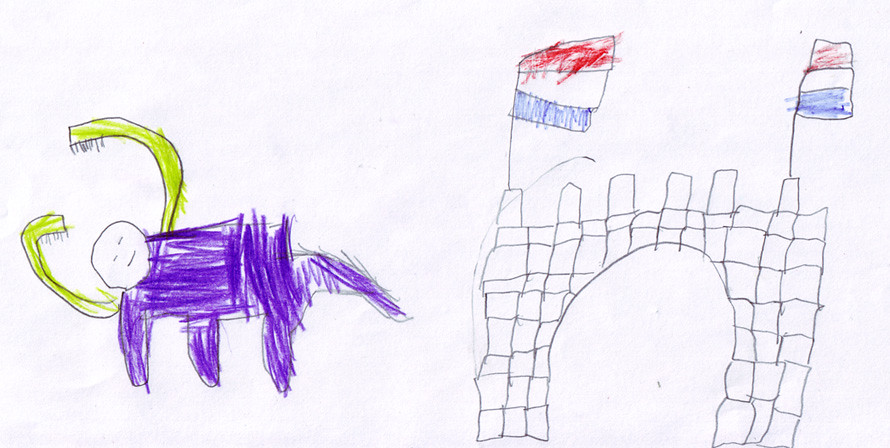
The first drawing I commissioned was the obligatory drawing of a displacer beast. Mathijs also drew the castle it lives in.
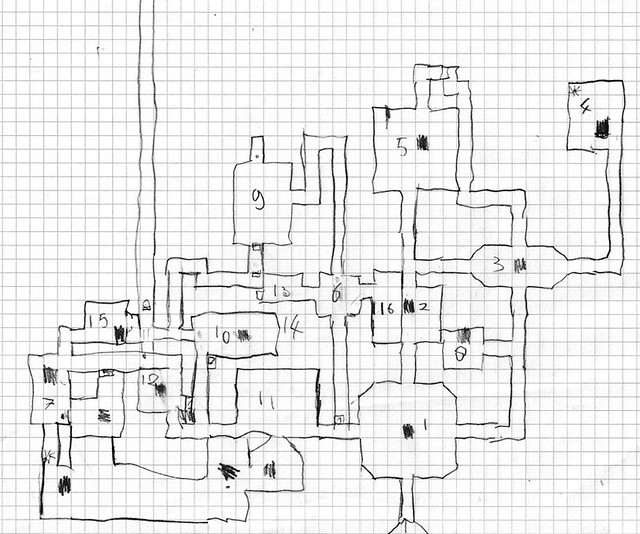
For the other drawing, I asked Mathijs to design a sub-level of the castle for me. The way he went about it was fun: He drew the first room, and asked me: ‘What do you do?’ When I went west, he drew the next room, and there I encountered either a monster or a statue. So I played through the entire dungeon, and he stocked it in the process. So this will be the Displacer Beast Level of Castle Verge:
The black squares are statues. At the foot of the statue in area #5 is a healing potion, in area #10 there’s a note saying ‘go to area #8’. The little sun symbols are treasure chests containing gold pieces.
In area #6 there’s a statue that is actually a troll with stony skin. There’s another troll in area #13. There are displacer beasts in areas #2, #7, #10, and the big room without a number in the south. Area #9 has a sugar monster (variant rust monster), #11 has a dust monster (another variant).

The very long corridor between areas #10 and #15 is an underground stream with a bridge and treasure in the water. My favorite feature of the dungeon is area #14, which is just the negative space between rooms with doors leading to it.

In area #5 there’s a trodon, a giant humanoid with two bellies, so it can eat two people:
Trodon (1d4): AL C, MV 90’ (30’), AC 4, HD 5+2, #AT 3 (1 bite and 2 claws, or 1 weapon), Dmg 1d8 (bite), 1d10 (claw) or by weapon, SV F5, ML 10, XP 500.

Swallow whole: On an attack roll of 19-20, the trodon swallows the target whole. There’s room for one medium-sized creature or two halflings in each of his stomachs. A swallowed creature takes 1d10 damage each round.

Precision spit: After a swallowed creature is digested (brought two 0 hp), the trodon can spit out its remains as a ranged attack (short 20’, medium to 40’, long 60’, Dmg 1d6).

After I left, Mathijs apparently continued playing with his mother, because later on I found this map. The ‘)’ symbols on the map are cupcakes.

Monday, May 28, 2012

New Monster: Blistering Beast

My brother Jorrit and I decided to start a new project together. Over the coming weeks, we’ll be creating some new monsters; I’m writing them up for old-school games (as well as drawing them), and Jorrit does Pathfinder stats. Here’s the first one.
Blistering Beast
Armor Class: 3
Hit Dice: 7
Move: 90’ (30’)
Swimming: 90’ (30)
Attacks: 1 bite + special
Damage: 2d8
No. Appearing: 1 (1d3)
Save As: F3
Morale: 7
Treasure Type: See below
Intelligence: 2
Alignment: Neutral
XP Value: 1,250
The blistering beast, also known as the river boiler, is a magical monster most commonly found in subtropical rivers. It is about 20’ long, and has a hard, stony shell both for protection as well as camouflage.
When hunting, the beast lies in waiting just below the surface, the numerous humps on its back showing above the water. To passersby, the beast’s back looks exactly like convenient stepping stones to cross the river. When a potential meal uses it as such, the blistering beast will wait patiently until the victim reaches the middle of the river. Then it attacks.
The blistering beast can cause its Shell to become extremely hot, burning any creature touching it for 1d6 fire damage, and boiling the water within a 10’ radius. Creatures in the boiling water take 1d6 damage each round until they reach safer waters.
Blistering beasts normally don’t have treasure, but the possessions of previous victims might be found in the water.
BLISTERING BEAST              CR 7
XP 3,200
N Huge magical beast (aquatic, fire)
Init +3; Senses low-light vision, darkvision 60ft.; Perception +4
DEFENSE
AC 20, touch 7, flat-footed 20 (+13 natural, -2 size, -1 dex)
hp 85 (9d10 + 36)
Fort  +9, Ref +4, Will +3
Immune fire
Weaknesses cold
OFFENSE
Speed 20 ft., swim 30 ft., sprint
Melee bite +14 (4d8 + 10) plus burn, grab
Space 10 ft.; Reach 5 ft.
Special Attacks Boil Water, Burn (2d6, DC 18), Heat
STATISTICS
Str 24, Dex 8, Con 18, Int 2, Wis 12, Cha 6
Base Atk +3; CMB +18; CMD 27
Feats Improved Initiative, Improved Natural Weapon, Run, Skill Focus (Perception, Stealth)
Skills Perception +4, Stealth +6 (+14 in water); Racial Modifiers +8 Stealth in water
SQ Water Dependency
ECOLOGY
Environment subtropical rivers
Organization solitary or pair
Treasure none
SPECIAL ABILITIES
Boil Water (Ex) The blistering beast’s heat boils the water within a 10’ radius. Creatures in the boiling water take 1d6 fire damage each round until they reach safer waters.
Heat (Ex) Merely touching or being touched by a blistering beast automatically deals 2d6 fire damage.
Sprint (Ex) Once per minute a crocodile may sprint, increasing its land speed to 40 feet for 1 round.
Water Dependency (Ex) Blistering beasts can survive out of the water for 1 minute per point of Constitution. Beyond this limit, a blistering beast runs the risk of suffocation, as if it were drowning.